Articles · Life
How to stop comparing yourself to others
Everyone else seems to be ahead. Here is why it feels that way, and what to do with it.
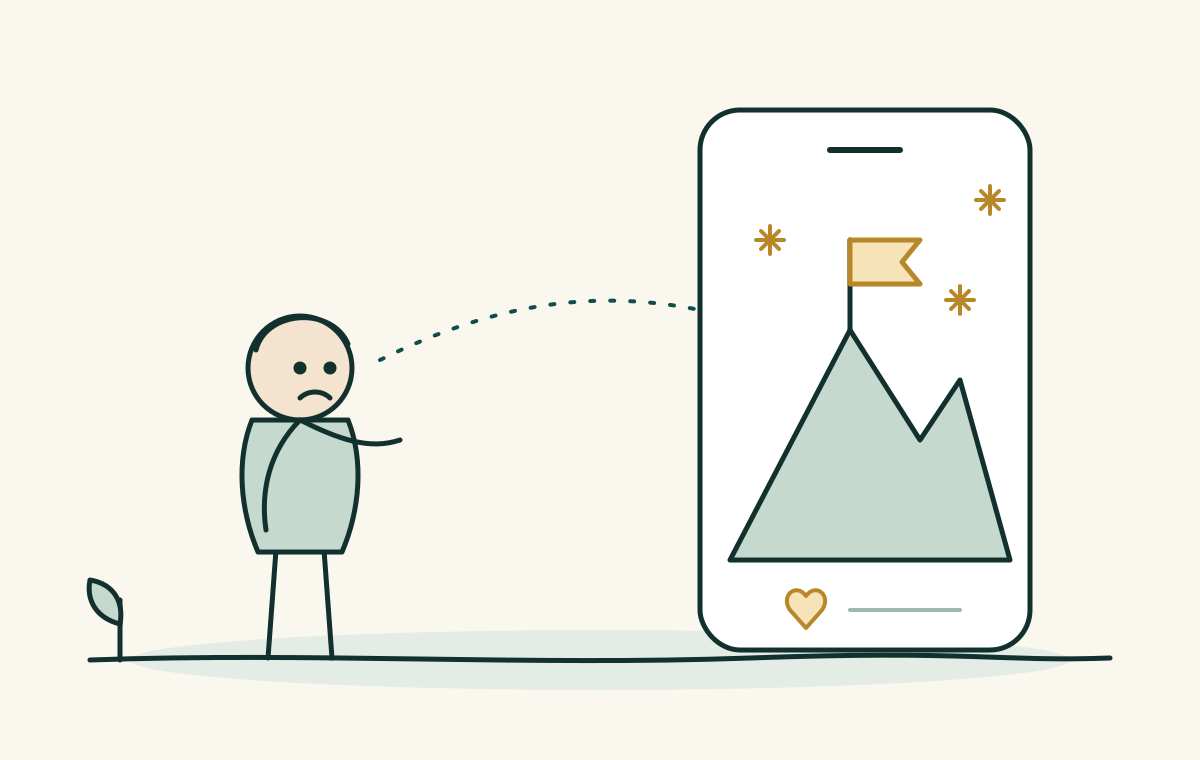
You open your phone for two minutes. Someone got promoted. Someone bought a house. Someone is on a beach. You close the app feeling smaller than when you opened it.
Comparing is normal
You are not shallow for doing this. In 1954 the psychologist Leon Festinger described what he called social comparison: people work out how they are doing by looking at the people around them, especially when there is no clear measure to go by.
Looking at someone who is doing better is called upward comparison. Sometimes it inspires you. Often it just hurts.
Why social media makes it sting
Online, you can make hundreds of upward comparisons before breakfast. Researchers have looked at what that does.
- A 2014 study found that the people who used Facebook most tended to have lower self-esteem, and that seeing more upward comparisons helped explain the link.
- A 2020 study followed people through browsing sessions. The more often they compared upward, and the bigger the gap, the worse they rated themselves right after, with lower mood and life satisfaction. People who already had low self-esteem were hit hardest.
- The American Psychological Association notes that what we compare against online is often incomplete or heavily edited.
So the match is unfair from the start. You know your whole story. You see their best ten seconds.
A fair note: these studies show a pattern, not a rule. Not everyone is affected in the same way, and social media can also connect and encourage people.
Five ways to loosen its grip
- Name it. When the feeling lands, say it plainly: “I am comparing.” A named feeling is easier to step back from.
- Compare with your past self. Write down one thing you can do now that you could not do a year ago. That is the only comparison with all the facts.
- Clean up your feed. Mute one account that leaves you feeling worse every time. You do not owe anyone your attention.
- Read envy as information. Envy points at something you want. Ask, “What exactly do I want here?” Then pick one small step toward it.
- Set an edge. Choose a time when the apps close, and keep your phone out of reach for the first and last half hour of the day.
You are not behind. You are on your own track.
Keep going
- Lesson 3: The comparison trap
- Our illustrated guide: When You Feel Behind
- Books on comparison and self-worth
Sources
- Social comparison, social media, and self-esteem (Vogel, Rose, Roberts and Eckles, 2014), Psychology of Popular Media Culture
- When every day is a high school reunion: Social media comparisons and self-esteem (Midgley and colleagues, 2020), Journal of Personality and Social Psychology
- Students experiencing social comparison via the social media mirror, American Psychological Association
This article is general self-help information, not medical advice. If you are struggling, talk to a doctor or a mental health professional.